As optical interconnects scale relentlessly toward 800G/1.6T modules,co-packaged optics (CPO), and silicon photonics, Fiber Array Units (FAUs) have quietly emerged as the precision engines driving this transformation. However, one critical performance factor is often dangerously underestimated: thermal stress.
Why Thermal Stress Is the Silent Killer of Optical Performance
In the rush to scale, most engineering focus is rightfully placed on initial alignment precision and coupling efficiency. Yet, thermal reliability frequently becomes the hidden bottleneck preventing successful mass deployment:
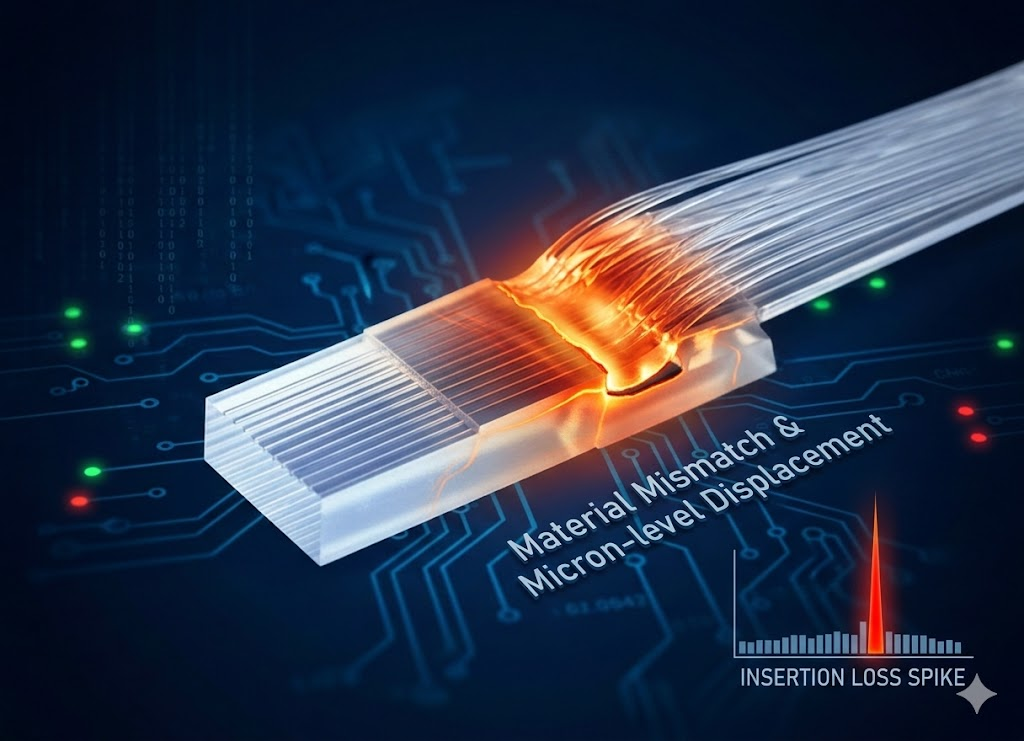
Material CTE Mismatch:An FAU is a composite structure. Glass fibers, optical adhesives, and lid/substrate materials (silicon, glass, or ceramic) all expand differently under heat. This coefficient of thermal expansion (CTE) mismatch is a primary cause of micro-cracks, delamination at the adhesive interface, and subtle, hard-to-detect reliability failures.
Micron-Level Sub-critical Misalignment:Optical coupling in single-mode systems is unforgiving. Thermal cycling can shift fiber positions by mere microns. While seemingly negligible, this is sufficient to cause significant insertion loss spikes and permanently degrade coupling efficiency over time.
Long-Term Reliability Drift:The damage is often cumulative. Over thousands of thermal cycles (representing years of data center operation), performance degrades slowly but steadily. This creates yield loss and field failures that only surface after deployment at scale.
The Scaling Trap:Designs that pass qualification in small NPI batches often experience catastrophic failure rates when deployed in mass production. The complex interaction of thermal stress across thousands of FAUs is a problem that only reveals itself when volume scales up.
The Pain Points You Need to Know
The core takeaway for optical module designers is this: FAUs are not "just passive connectors"—they are active determinants of system reliability.
A single micron of thermal drift can compromise the entire module’s signal integrity and performance.
Ignoring FAU thermal stress during the design phase risks substantial hidden costs, extensive warranty claims, and customer dissatisfaction.
Proactive Mitigation Strategies
To address these critical challenges, industry leaders are adopting robust design and material strategies:
1.Low-CTE Matched Materials: Selecting substrate, lid, and adhesive materials with CTEs closely matched to the optical fibers and the mating PIC (Photonic Integrated Circuit).
2.Stress-Relief Structures: Incorporating compliant features or stress-relief zones within the FAU mechanical design to absorb material expansion and contraction without transferring stress to the fiber-adhesive interface.
3.High-Tg Adhesives: Utilizing advanced optical adhesives with high glass transition temperatures (Tg) that can withstand repeated, high-temperature thermal cycling without softening or losing structural integrity.
4.Rigorous Validation: Implementing accelerated thermal cycling and damp heat testing as standard validation steps before committing to mass deployment.
Call to Action: Elevating FAU Thermal Reliability
As bandwidth demand accelerates, the components enabling that speed must be robust. FAUs must be treated as first-class, critical design parameters. Reliability under thermal stress is not an afterthought or a line item on a spec sheet—it is the difference between scalable market success and expensive, hidden failure.
The Bottom Line: FAUs are the silent enablers of next-generation optical interconnects. Attempting to scale demand without directly addressing thermal stress is a recipe for reliability crises. The optical industry must shine a spotlight on FAU thermal reliability.



